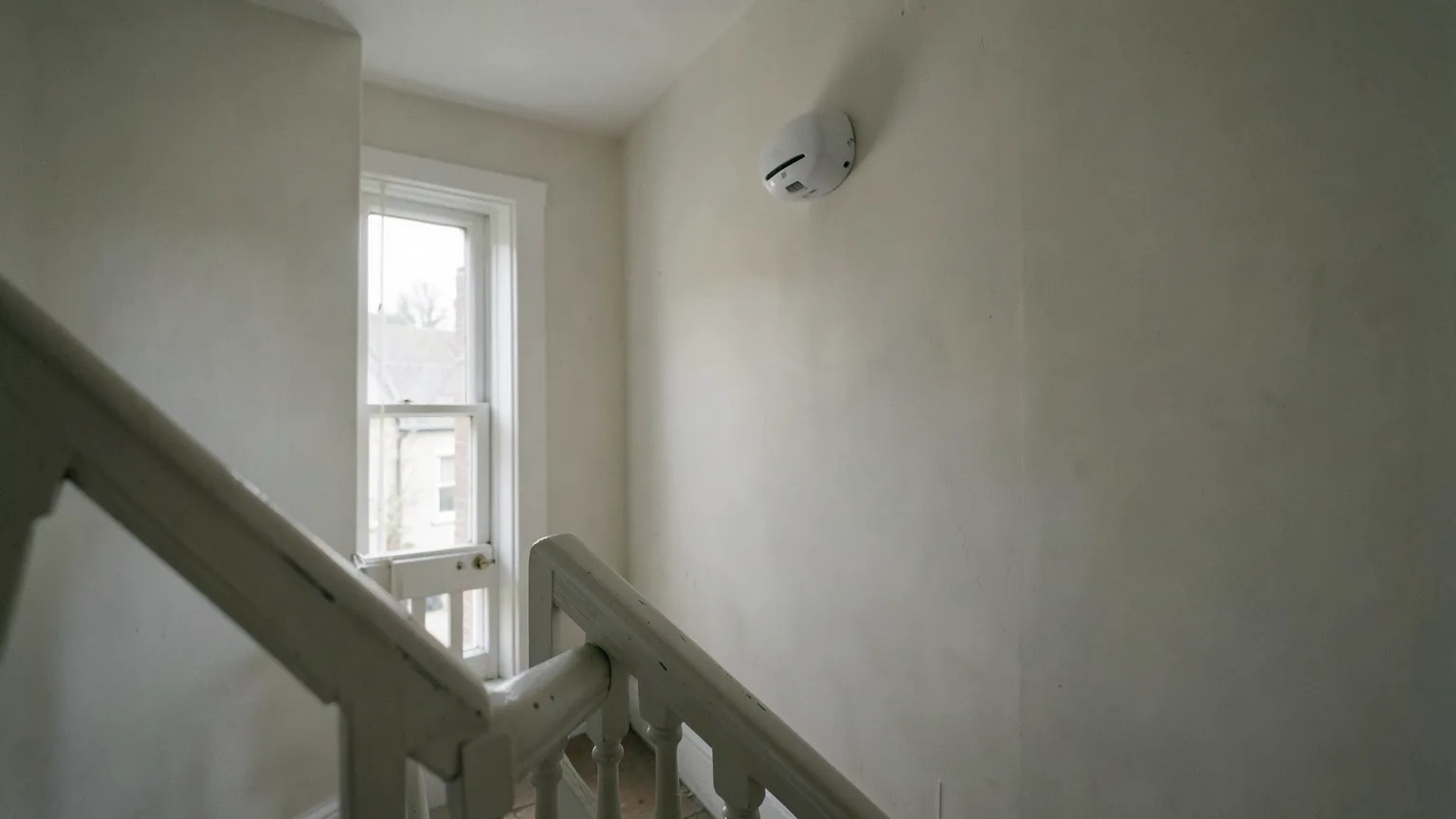
Smoke and carbon monoxide alarms in Exeter lettings
Landlords letting a home in Exeter must fit smoke alarms and, where a fixed combustion appliance is present, carbon monoxide alarms, and must check that they work when a tenancy begins. The rules come from the Smoke and Carbon Monoxide Alarm (England) Regulations 2015, as changed in 2022 to widen the carbon monoxide requirement from solid fuel appliances to most fixed combustion appliances, to bring social landlords within the rules and to add a repair duty. This guide sets out which alarms are needed, where they go, what the checks involve and how the mains and battery options compare.
The basic duty on the landlord
The duty sits with the landlord, and it applies when the premises are occupied under a tenancy that falls within the regulations. Under regulation 4, a relevant landlord must make sure that a smoke alarm is fitted on each storey that contains a room used wholly or partly as living accommodation. The regulation also treats a bathroom or lavatory as living accommodation for this purpose, so a landing with a bathroom off it needs an alarm even where the bathroom itself is small.
The rules are set out in the landlord and tenant guidance issued after the 2022 amendment. That guidance explains how the duties apply to different types of letting and which tenancies are excluded, so it is worth reading alongside the regulations before a property is listed.
Carbon monoxide alarms
Carbon monoxide alarms are required in any room used wholly or partly as living accommodation that contains a fixed combustion appliance, other than a gas cooker. In practice, that means a room with a gas boiler, a gas fire, a solid fuel stove or another fixed heater that burns fuel. The regulation is specific about the appliance type, so the landlord should walk the property and note each appliance, rather than relying on a general assumption.
The health reason is the same as the legal one. The NHS guidance on carbon monoxide poisoning explains that the gas is colourless and has no smell, so people cannot detect it, and that symptoms such as headache, dizziness and sickness can come and go. It recommends a carbon monoxide alarm in each room containing appliances that burn gas, oil, coal or wood, which matches the approach taken in the regulations.
The 2022 change
The 2022 amendment took effect on 1 October 2022. Before it, private landlords only had to provide a carbon monoxide alarm in a room containing a solid fuel appliance; the amendment extended that to any fixed combustion appliance other than a gas cooker, applied the rules to social landlords as well, and added a duty to repair or replace a faulty alarm after a report by the tenant. The government guidance for landlords and tenants records these changes, and the regulation text confirms that the repair duty applies to reports made on or after 1 October 2022. A landlord who has let a property for some time should check that its alarms meet the current requirements, not just the rules in force when the tenancy was first granted.
Checks at the start of a tenancy
Where a tenancy is new, the regulations require the landlord to make checks, by or on behalf of the landlord, to ensure that each prescribed alarm is in proper working order on the day the tenancy begins. Regulation 4 defines a new tenancy as one granted on or after 1 October 2022, subject to exclusions for tenancies agreed before that date, and it defines the start of a tenancy as the day the tenant becomes entitled to possession under its terms.
The check is simple to carry out. Test each smoke alarm using its test button, confirm that each carbon monoxide alarm shows a working status, and record the date and the name of the person who carried out the check. Write the results in the tenancy file, so that a dispute about the condition of the alarms at the start can be settled quickly.
Mains or battery alarms
Both mains-wired and battery alarms can meet the requirements: the government's question and answer booklet for landlords says the regulations do not stipulate either type, recommends smoke alarms that comply with BS 5839-6, and says that where battery alarms are chosen, sealed-for-life batteries are the better option than replaceable ones. Mains alarms are wired into the property's electrical supply, usually with a battery back-up, and they can be linked so that one alarm sounds the others. Battery alarms are simpler to fit and do not need an electrician, but the battery must be checked and replaced on schedule. Ask the landlord's installer which type suits the property and whether linked alarms are preferable on a multi-storey home.
For a landlord with several properties, a consistent approach is easier to manage. Choosing one type across the portfolio simplifies the checks, the replacement schedule and the records. Whichever type is chosen, the alarm must be in proper working order at the start of each new tenancy and must be repaired or replaced after a report from the tenant.
Repairs after a tenant report
From 1 October 2022, a prescribed alarm found not to be in proper working order following a report by the tenant must be repaired or replaced. The regulation requires the determination and any repair to be carried out by or on behalf of the landlord as soon as reasonably practicable. That wording means a repair cannot be left for a convenient time, and a log of reports and responses is the strongest evidence if the arrangement is ever questioned.
Keep a simple record of each report, the date it was received, the visit or repair that followed and the result of the next check. The record protects the landlord and the tenant, and it makes the next tenancy easier to manage.
Penalties and enforcement
The 2015 regulations give the local housing authority powers to act where a landlord does not meet the duties. The regulations contain a remedial notice procedure and a penalty charge regime, and they set out appeals and the way a penalty can be recovered. Where the council has reasonable grounds to believe an alarm duty has been breached it must serve a remedial notice, and the landlord then has 28 days to take the action it specifies. Under regulation 8, a landlord who fails to comply can be required to pay a penalty charge of up to £5,000, and the booklet notes that penalties apply per breach. HMOs that need a licence, and houses licensed under a selective scheme, sit outside these duties because their licences carry equivalent alarm conditions. The sensible course is to fit the correct alarms and keep the checks on record from the start.
Certificates and electrical safety
Smoke and carbon monoxide alarms are a separate duty from the electrical safety rules for a private rental. A property may meet both sets of requirements, but a working alarm does not prove the wiring is safe, and a satisfactory electrical report does not prove the alarms are in place. Check both, and keep the records together. A landlord's inspection and report can cover the fixed wiring, while the alarm checks are carried out separately.
Where the alarms are mains-wired, the installer should record the circuit they sit on and confirm that the work is included in the electrical certificate. Where an alarm is added or moved, a short note on the paperwork helps the next inspector understand the installation.
Working through the property
A practical sequence for a landlord letting in Exeter, and one that suits the quote comparison in the guide on spotting extras in a quotation, is to list each storey and room, mark the rooms with fixed combustion appliances, fit the alarms in the right places and test them before the tenant moves in. Give the tenant written information about where the alarms are, how to test them and who to contact if one fails. That information is part of the tenancy and makes the repair duty easier to meet.
Landlords with properties in Heavitree or Countess Wear should apply the same sequence to each home, with the local layout dictating where the alarms sit. The principles stay the same across the city.
Getting help with the work
If the property needs new wiring for mains alarms, or the existing wiring cannot take them, a fault-finding visit can identify the cause before any alarm is fitted. Where a mains alarm is added to a circuit, the installer should note the change on the certificate, because the inspection that follows will need to know which circuit feeds the alarm. Where the fixed wiring also needs renewal, the landlord should ask for a quote that covers the alarms, the testing and the paperwork together. The request a quote page is a practical way to ask for comparable offers.
Sources and further reading
- Smoke and Carbon Monoxide Alarm (England) Regulations 2015, regulation 4 (legislation.gov.uk)
- Smoke and Carbon Monoxide Alarm (England) Regulations 2015, regulation 8: penalty charge (legislation.gov.uk)
- Smoke and Carbon Monoxide Alarm (Amendment) Regulations 2022: guidance for landlords and tenants (GOV.UK)
- The Smoke and Carbon Monoxide Alarm (England) Regulations 2015: Q&A booklet for the private rented sector (GOV.UK)
- Carbon monoxide poisoning (NHS)